


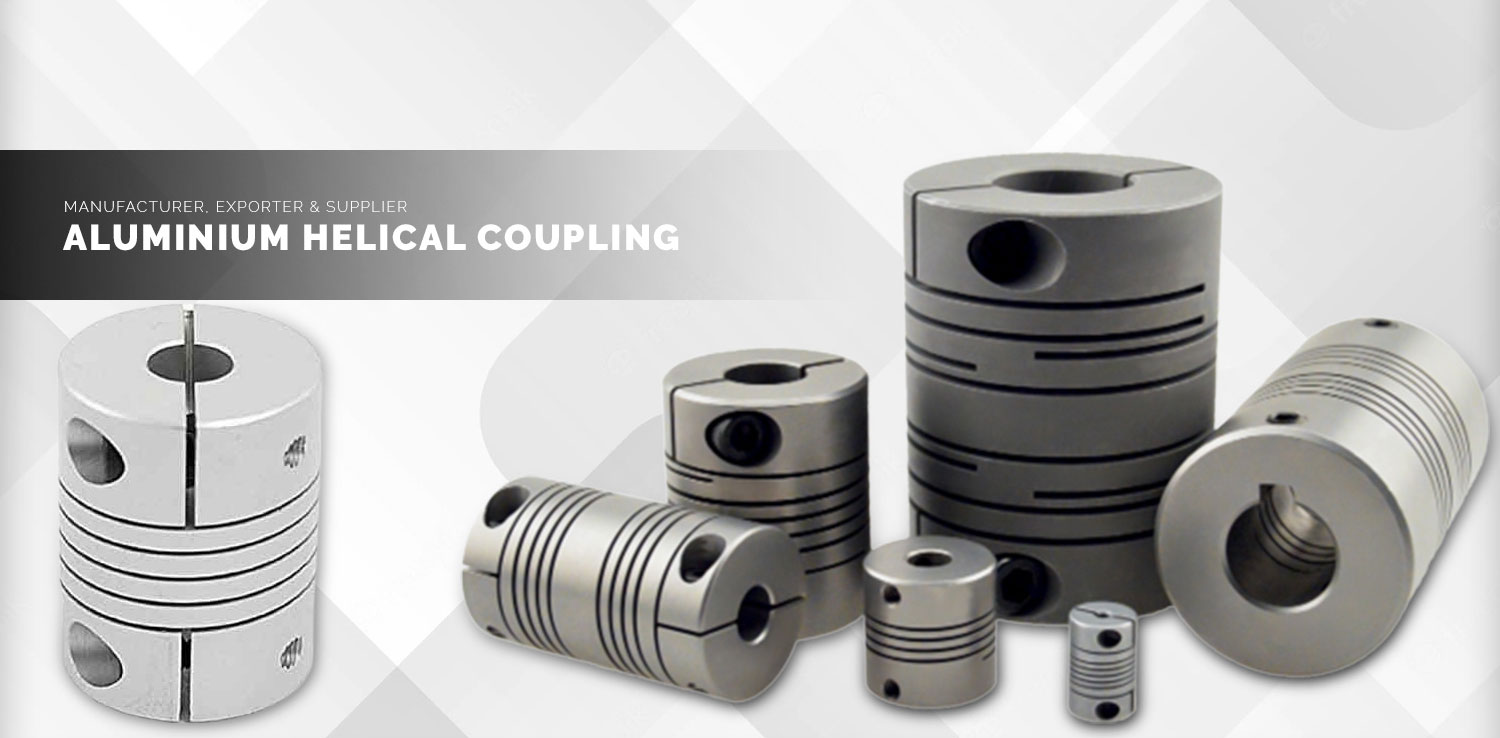
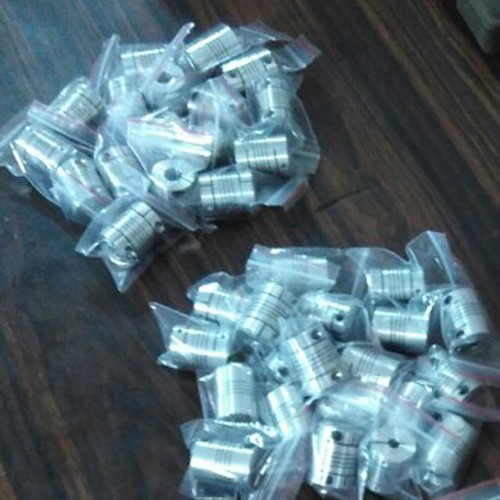
Aluminum Spiral Beam Coupling
200.00 - 225.00 INR/Piece
Product Details:
- Head Code Round
- Material Aluminum
- Inner Diameter 6 Millimeter (mm)
- Outer Diameter 25 Millimeter (mm)
- Application Automation
- Technique Other
- Shape Round
- Click to view more
X
Aluminum Spiral Beam Coupling Price And Quantity
- 200.00 - 225.00 INR/Piece
- 11 Piece
Aluminum Spiral Beam Coupling Product Specifications
- Round
- Other
- 25 Millimeter (mm)
- Aluminum
- Round
- Automation
- 6 Millimeter (mm)
Aluminum Spiral Beam Coupling Trade Information
- 1000 Piece Per Month
- 1 Days
- Yes
- Sample costs shipping and taxes has to be paid by the buyer
- Box Packaging
- Australia, North America, South America, Eastern Europe, Middle East, Africa, Central America, Western Europe, Asia
- All India
Product Description
Aluminum Spiral Beam Coupling
is a mechanical tool designed to connect two revolving shafts together. The device is designed and developed in our state of the art production division with the help of advanced tools and cutting-edge technology. For this reason, the application of spiral coupling results in the elimination of the misalignment and installation errors. It is made of the well-tested aluminium that is widely known for its sturdiness and anti-corrosion property, therefore,Aluminum Spiral Beam Coupling
does not lose its quality for the years.
Technical Specifications
| Model | "D" outer diameter | "D1" Bore diameter | "D2" Bore diameter | "L" Length | Model | "D" Outer diameter | "D1" Bore diameter | "D2" Bore diameter | "L" length |
| CSA144-525 | 14 | 4 | 5 | 25 | CSA3012-1535 | 30 | 12 | 15 | 35 |
| CSA205-825 | 20 | 5 | 8 | 25 | CSA3012-1538 | 30 | 12 | 15 | 38 |
| CSA256-632 | 25 | 6 | 6 | 32 | CSA3212-1538 | 32 | 12 | 15 | 38 |
| CSA256-832 | 25 | 6 | 8 | 32 | CSA3214-1630 | 32 | 14 | 16 | 30 |
| CSA256-1032 | 25 | 6 | 10 | 32 | CSA3214-1635 | 32 | 14 | 16 | 35 |
| CSA258-832 | 25 | 8 | 8 | 32 | CSA3818-2045 | 38 | 18 | 20 | 45 |
| CSA258-1032 | 25 | 8 | 10 | 32 | CSA3818-2048 | 38 | 18 | 20 | 48 |
| CSA2510-1032 | 25 | 10 | 10 | 32 | CSA4220-2357 | 42 | 20 | 23 | 57 |
| CSA288-1035 | 28 | 8 | 10 | 35 | CSA4220-2360 | 42 | 20 | 23 | 60 |
| CSA288-1435 | 28 | 8 | 14 | 35 | CSA4823-2860 | 48 | 23 | 28 | 60 |
| CSA2810-1135 | 28 | 10 | 11 | 35 | CSA5228-2860 | 52 | 28 | 28 | 60 |
| CSA2810-1435 | 28 | 10 | 14 | 35 | CSA5228-2870 | 52 | 28 | 28 | 70 |
Reliable Solution for Automation Needs
Our Aluminum Spiral Beam Coupling is engineered to cater specifically to automation applications. Its robust construction and precise dimensions provide outstanding flexibility and reduce the risk of mechanical failure. Built from premium-grade aluminum, this coupling is lightweight yet strong, making it an ideal choice for manufacturers who demand durability and efficiency in automated systems.
Custom Manufacturing and Export from India
As a leading Indian exporter, manufacturer, and supplier, we adhere to stringent industry standards and quality control measures. Each coupling undergoes rigorous testing to ensure consistent performance and longevity. Our streamlined supply chain allows us to deliver reliable couplings for both domestic and international customers quickly and efficiently.
FAQs of Aluminum Spiral Beam Coupling:
Q: How is the Aluminum Spiral Beam Coupling installed in automation equipment?
A: The coupling is easily installed by sliding the ends onto the shafts of the connected components, ensuring the 6 mm inner diameter aligns precisely. It is then tightened using standard fasteners to provide secure torque transmission within automated systems.Q: What benefits does the spiral beam design offer in automation applications?
A: The spiral beam structure provides superior flexibility, allowing the coupling to compensate for angular, parallel, and axial misalignments. This reduces wear on connected machinery parts and promotes longer service life and smooth performance.Q: When should I use an aluminum coupling with a 6 mm inner diameter and 25 mm outer diameter?
A: This coupling size is ideal when connecting shafts of 6 mm diameter within systems requiring a compact yet resilient component, such as robotics, CNC machines, or conveyor systems in automation setups.Q: Where is the Aluminum Spiral Beam Coupling commonly used?
A: The coupling is widely used in automation industries, including robotics, packaging, assembly lines, and advanced manufacturing units, to facilitate accurate and synchronized power transfer between mechanical parts.Q: What is the manufacturing process for this aluminum coupling?
A: The couplings are manufactured using high-precision CNC machining processes from top-grade aluminum. The spiral beam section is precisely cut to ensure elasticity and accurate misalignment compensation.Q: How does using this coupling benefit automation system performance?
A: By minimizing misalignment stress and providing reliable torque transmission, this coupling enhances the overall efficiency and longevity of automation systems, reducing maintenance requirements and downtime.Tell us about your requirement

Price:
Quantity
Select Unit
- 50
- 100
- 200
- 250
- 500
- 1000+
Additional detail
Mobile number
Email

Other Products in 'Aluminum Spiral Coupling' category


Address
GST : 24APHPP3348E1ZZ
- Shed No-27, Siddhi Estate, Near Shrinathji Estate, Panna Estate Road, Rakhial,Ahmedabad - 382415, Gujarat, India
- Phone : 07971191159
- Mr Rohit Patel
- Mobile :07971191159
- Mr. Gopal Patel
- Mobile :07971191159
- Send Inquiry
 Send Inquiry
|

 Send Inquiry
 Send SMS
HIGHWIN INDUSTRIES
All Rights Reserved.(Terms of Use)
Developed and Managed by Infocom Network Private Limited.
Developed and Managed by Infocom Network Private Limited.

